
By Baljit Singh
Chairman, Guru Nanak Global Foundation | PurePlanet Global Ventures LLC | Fab Guardians LLC
Email: bsingh@gndgu.com
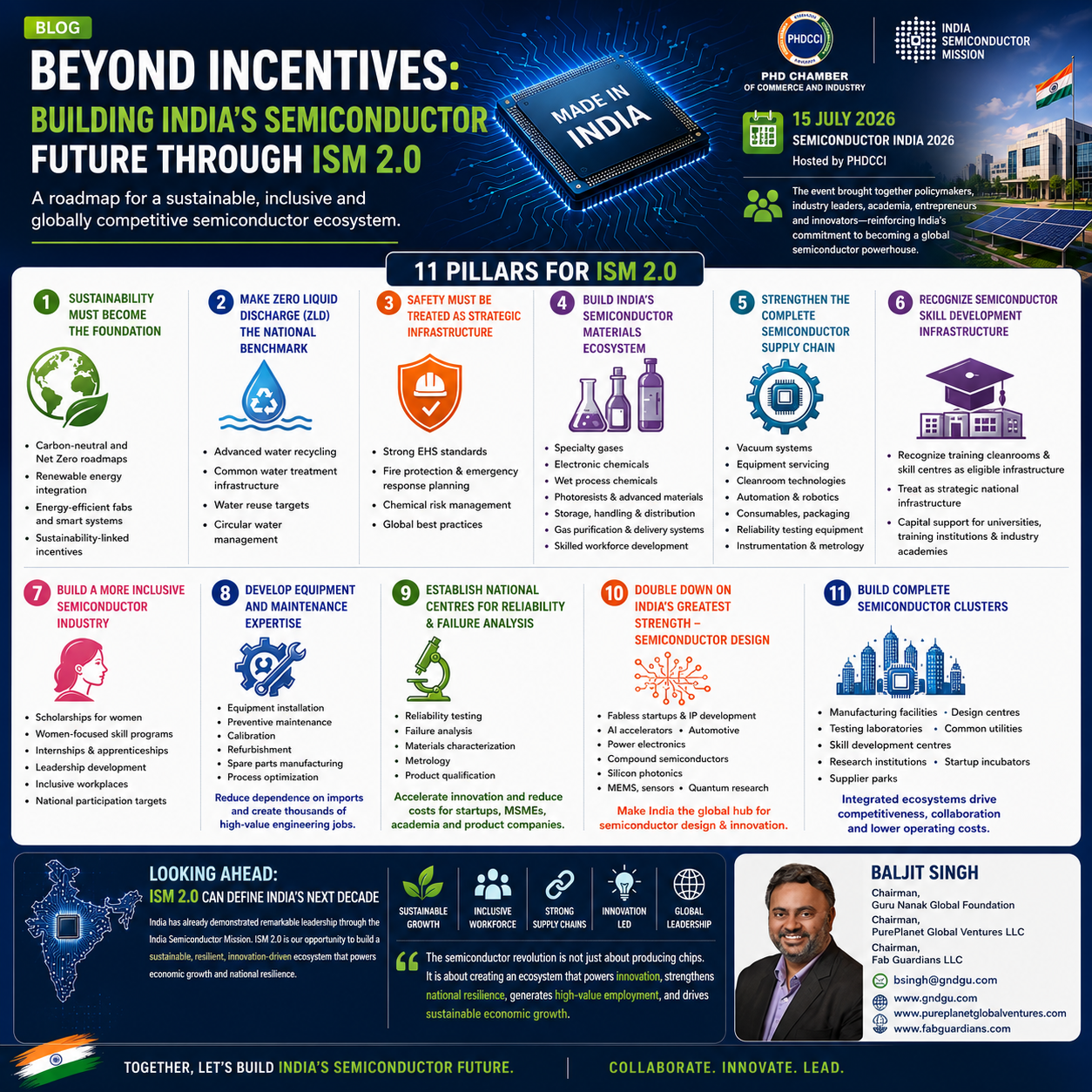
On 15 July 2026, I had the privilege of attending SEMICONDUCTOR INDIA 2026, hosted by the PHD Chamber of Commerce and Industry (PHDCCI). The event brought together policymakers, industry leaders, academia, entrepreneurs, and innovators under one roof, reinforcing India’s unwavering commitment to becoming a global semiconductor powerhouse.
I extend my sincere congratulations to Dr. Jatinder Singh, Shri Amitesh Kumar Sinha, and the entire organizing team for curating a meaningful platform that encouraged dialogue, collaboration, and a shared vision for India’s semiconductor future.
Over the past few years, the India Semiconductor Mission (ISM) has successfully laid the foundation for attracting semiconductor investments and positioning India on the global semiconductor map. However, as we enter the next phase of growth, ISM 2.0 presents an opportunity to evolve from an investment-driven initiative into a comprehensive national ecosystem strategy.
India has the opportunity not merely to replicate existing semiconductor hubs but to build the world’s most sustainable, resilient, inclusive, and innovation-driven semiconductor ecosystem.
1. Sustainability Must Become the Foundation
Every semiconductor facility approved under ISM 2.0 should be designed with sustainability at its core.
India has the opportunity to become home to some of the world’s greenest semiconductor facilities by encouraging:
- Carbon-neutral and Net Zero manufacturing roadmaps.
- Renewable energy integration through solar, wind, battery storage, and green hydrogen.
- Energy-efficient fabs powered by digital energy management systems.
- Sustainability-linked incentives tied to measurable environmental outcomes.
Future competitiveness will increasingly depend not only on manufacturing capability but also on environmental responsibility.
2. Make Zero Liquid Discharge the National Benchmark
Semiconductor manufacturing is among the most water-intensive industries in the world.
India should establish Zero Liquid Discharge (ZLD) as the standard for new semiconductor fabs, ATMP/OSAT facilities, and advanced packaging plants.
Policy support should encourage:
- Advanced water recycling technologies.
- Common water treatment infrastructure within semiconductor parks.
- Water reuse targets.
- Circular water management systems.
Responsible water stewardship will be critical to ensuring long-term sustainability and community acceptance.
3. Safety Must Be Treated as Strategic Infrastructure
Semiconductor manufacturing involves hazardous chemicals, specialty gases, and highly sophisticated manufacturing environments.
Safety should not simply be a compliance requirement—it should become a strategic pillar of ISM 2.0.
India should establish national semiconductor standards covering:
- Environmental, Health and Safety (EHS).
- Fire protection systems.
- Emergency response planning.
- Chemical risk management.
- Global operational best practices.
Safe facilities are productive facilities.
4. Build India’s Semiconductor Materials Ecosystem
A semiconductor ecosystem cannot thrive without domestic capabilities in critical materials.
Priority investments should focus on:
- Ultra-high purity specialty gases.
- Electronic chemicals.
- Wet process chemicals.
- Photoresists.
- Chemical storage and distribution.
- Gas purification and delivery systems.
Equally important is building a skilled workforce capable of safely handling these advanced materials.
5. Strengthen the Complete Semiconductor Supply Chain
Success in semiconductors extends far beyond fabs.
India must simultaneously develop industries supporting semiconductor manufacturing, including:
- Vacuum systems.
- Semiconductor equipment servicing.
- Cleanroom technologies.
- Precision manufacturing.
- Automation and robotics.
- Packaging materials.
- Reliability testing equipment.
- Analytical instrumentation.
- Metrology solutions.
Supporting these sectors through targeted incentives will deepen localization, strengthen resilience, and attract additional global investment.
6. Recognize Semiconductor Skill Development Infrastructure
One of the most significant policy gaps today is that Semiconductor Skill Development Centres, Training Cleanrooms, and Applied Learning Facilities are often not recognized as eligible infrastructure under many state incentive schemes.
This creates an unintended barrier to workforce development.
Training infrastructure should be treated as strategic national infrastructure alongside manufacturing facilities.
Supporting universities, industry academies, and semiconductor training centers through capital incentives will help ensure India develops the workforce needed to support future growth.
7. Build a More Inclusive Semiconductor Industry
The semiconductor industry represents an extraordinary opportunity to increase women’s participation across advanced manufacturing and engineering.
A national strategy should include:
- Scholarships for women pursuing semiconductor careers.
- Dedicated skill development programs.
- Industry internships and apprenticeships.
- Leadership development pathways.
- Inclusive workplace infrastructure.
- National participation targets across technical and leadership roles.
A stronger industry begins with a more diverse workforce.
8. Develop Semiconductor Equipment and Maintenance Expertise
Equipment represents one of the largest investments within semiconductor manufacturing.
India should develop domestic capabilities in:
- Equipment installation.
- Preventive maintenance.
- Calibration.
- Refurbishment.
- Spare parts manufacturing.
- Process optimization.
This capability will reduce reliance on overseas service providers while creating thousands of highly skilled engineering jobs.
9. Establish National Centres for Reliability and Failure Analysis
Many startups, universities, and product companies struggle to access advanced semiconductor testing facilities.
India would benefit significantly from establishing shared national centres dedicated to:
- Reliability testing.
- Failure analysis.
- Materials characterization.
- Metrology.
- Product qualification.
Such facilities would accelerate innovation while reducing development costs for emerging semiconductor companies.
10. Double Down on India’s Greatest Strength: Semiconductor Design
Manufacturing is essential, but India’s greatest competitive advantage continues to be its engineering talent.
ISM 2.0 should further accelerate investment in:
- Fabless semiconductor companies.
- Semiconductor IP development.
- AI accelerators.
- Automotive electronics.
- Power electronics.
- Compound semiconductors.
- Silicon photonics.
- MEMS and sensor technologies.
- Quantum semiconductor research.
India has the opportunity to become the world’s leading destination for semiconductor design and innovation.
11. Build Complete Semiconductor Clusters
Rather than isolated manufacturing investments, India should encourage integrated semiconductor clusters that combine:
- Manufacturing facilities.
- Design centres.
- Testing laboratories.
- Common utilities.
- Skill development centres.
- Research institutions.
- Startup incubators.
- Supplier parks.
Integrated ecosystems lower operating costs, encourage collaboration, and improve global competitiveness.
Looking Ahead: ISM 2.0 Can Define India’s Next Decade
India has already demonstrated remarkable leadership through the India Semiconductor Mission.
The next phase should focus on building an ecosystem that is not only capable of manufacturing chips but also developing talent, enabling innovation, strengthening domestic supply chains, and embedding sustainability into every aspect of growth.
If India embraces these priorities, ISM 2.0 can become much more than an industrial policy—it can become a national transformation strategy that positions the country as a trusted global leader in semiconductor technology.
The journey ahead requires continued collaboration between government, industry, academia, startups, and civil society. I remain optimistic that, together, we can build an ecosystem that future generations will regard as one of India’s defining technological achievements.
The semiconductor revolution is no longer about producing chips alone. It is about creating an ecosystem that powers innovation, strengthens national resilience, generates high-value employment, and contributes to sustainable economic growth. India has both the vision and the talent to lead this transformation—and ISM 2.0 is the opportunity to make that vision a reality.