Author: Fab Guardians

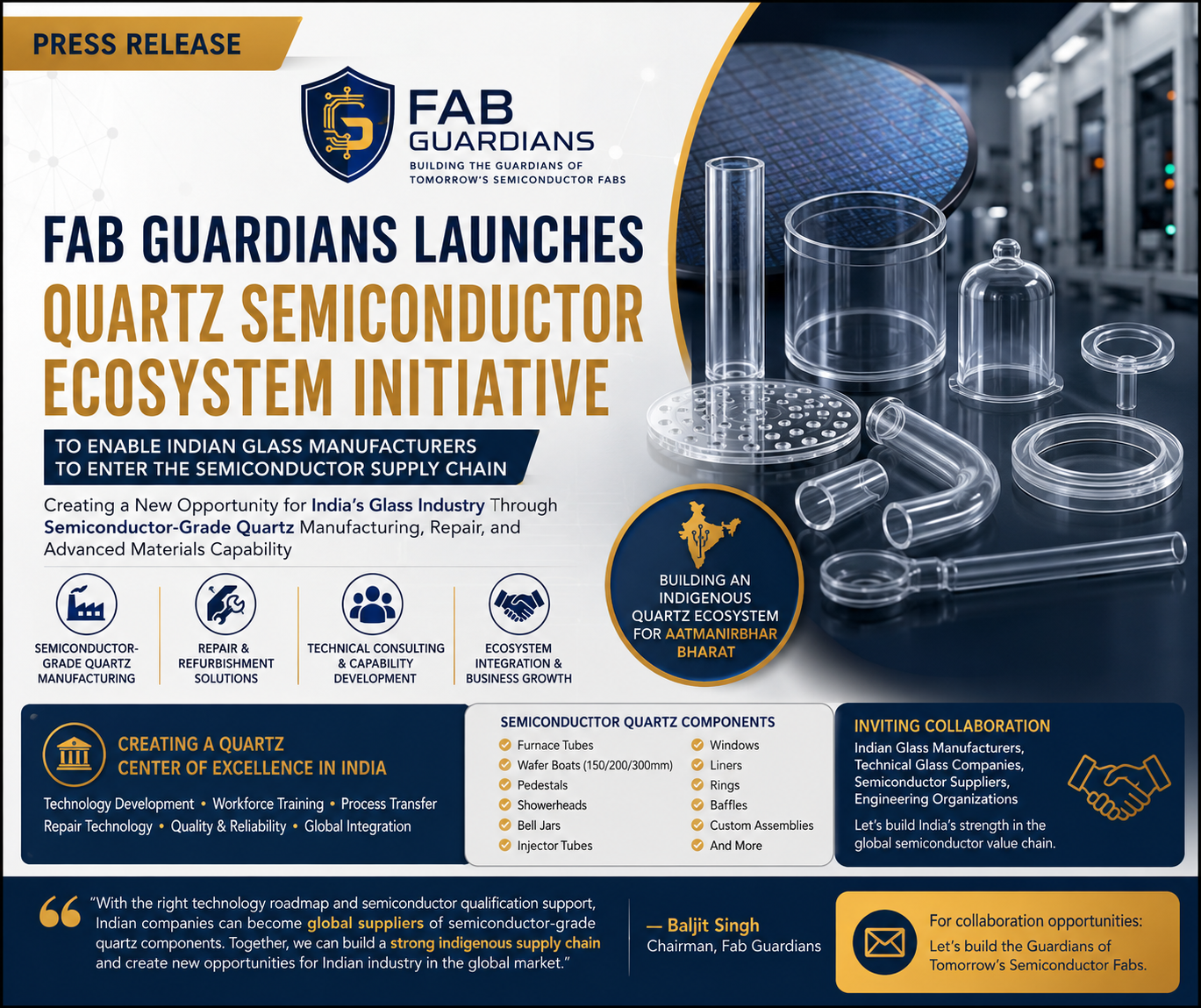
  • Fab Guardians Launches Quartz Semiconductor Ecosystem Initiative to Enable Indian Glass Manufacturers to Enter the Semiconductor Supply Chain

    Fab Guardians Launches Quartz Semiconductor Ecosystem Initiative to Enable Indian Glass Manufacturers to Enter the Semiconductor Supply Chain

    PRESS RELEASE | 31-July-2026

    Creating a New Opportunity for India’s Glass Industry Through Semiconductor-Grade Quartz Manufacturing, Repair, and Advanced Materials Capability

    Navi Mumbai, India — Fab Guardians, a semiconductor ecosystem development initiative focused on building indigenous capabilities for semiconductor manufacturing support, today announced the launch of its Quartz Manufacturing and Repair Ecosystem Initiative to support Indian glass manufacturers in developing semiconductor-grade quartz capabilities.

    The initiative aims to transform India’s existing glass manufacturing expertise into a globally competitive semiconductor materials ecosystem by providing technical consulting, capability development, process guidance, and ecosystem integration support to glass manufacturers interested in entering the semiconductor supply chain.

    Quartz is one of the most critical materials used in semiconductor fabrication due to its ultra-high purity, excellent thermal stability, low contamination characteristics, chemical resistance, and ability to withstand extreme process environments. Semiconductor-grade quartz components are essential for processes including oxidation, diffusion, LPCVD, PECVD, ALD, epitaxy, RTP, and wafer cleaning.

    Building the Bridge Between India’s Glass Industry and Semiconductor Manufacturing

    India has a strong foundation in glass manufacturing, technical glass processing, precision engineering, and industrial fabrication. Fab Guardians believes that with targeted technology development, process optimization, and semiconductor qualification support, Indian glass manufacturers can expand into high-value semiconductor quartz applications.

    Fab Guardians will work with glass manufacturers to develop capabilities in:

    • Semiconductor-grade fused quartz manufacturing
    • High-purity material handling
    • Quartz forming and fabrication technologies
    • Precision machining and finishing
    • Quartz welding and repair
    • Semiconductor cleaning and contamination control
    • Inspection and qualification methodologies
    • Customer engagement with semiconductor fabs and equipment companies

    Fab Guardians Consulting Services for Glass Manufacturers

    As part of this initiative, Fab Guardians will provide consulting and ecosystem-building services including:

    Technology Assessment

    • Evaluation of existing glass manufacturing capabilities
    • Gap analysis against semiconductor quartz requirements
    • Manufacturing roadmap development

    Process Development Support

    • Quartz fabrication process guidance
    • Equipment selection recommendations
    • Manufacturing workflow development
    • Cleanroom and contamination control practices

    Semiconductor Qualification Guidance

    • Understanding fab requirements
    • Quality system development
    • Inspection and metrology planning
    • Process validation support

    Business Ecosystem Development

    • Connecting glass manufacturers with semiconductor stakeholders
    • Supporting localization opportunities
    • Identifying high-value semiconductor applications
    • Developing strategic partnerships

    Semiconductor Quartz Components Covered

    The ecosystem initiative will focus on manufacturing and repair capabilities for:

    • Quartz furnace tubes
    • Quartz wafer boats for 150 mm, 200 mm, and 300 mm wafers
    • Quartz pedestals
    • Quartz showerheads
    • Quartz bell jars
    • Quartz injector tubes
    • Quartz windows
    • Quartz liners
    • Quartz rings
    • Quartz baffles
    • Custom semiconductor quartz assemblies

    Repair and Refurbishment Opportunity

    Fab Guardians will offer quartz repair and refurbishment capabilities, helping manufacturers establish services for:

    • Furnace tube restoration
    • Quartz welding
    • Crack repair
    • Slot restoration
    • Surface finishing
    • Fire polishing
    • Annealing
    • Semiconductor-grade cleaning
    • Component qualification

    These capabilities can significantly reduce semiconductor equipment downtime, extend component life, and create a sustainable circular economy for semiconductor consumables.

    Creating a Quartz Center of Excellence in India

    Fab Guardians envisions establishing a Quartz Center of Excellence in collaboration with Indian glass manufacturers, engineering companies, MSMEs, and semiconductor stakeholders.

    The center will focus on:

    • Semiconductor quartz technology development
    • Workforce training
    • Manufacturing process transfer
    • Repair technology development
    • Failure analysis
    • Quality and reliability improvement
    • Global semiconductor supply chain integration

    Call to Indian Glass Manufacturers

    Fab Guardians invites Indian glass manufacturers, technical glass companies, precision fabrication companies, and engineering organizations to join this emerging semiconductor ecosystem.

    Companies with expertise in:

    • Glass melting and processing
    • Technical glass fabrication
    • Precision machining
    • Industrial manufacturing
    • High-purity materials

    are encouraged to collaborate with Fab Guardians to explore opportunities in semiconductor quartz manufacturing and repair.

    Statement from Baljit Singh, Chairman, Fab Guardians

    “India’s semiconductor journey requires more than semiconductor fabs; it requires a complete ecosystem of materials, components, equipment services, and skilled capabilities. Our glass manufacturing industry has decades of experience, engineering talent, and manufacturing strength. With the right technology roadmap and semiconductor qualification support, Indian companies can become global suppliers of semiconductor-grade quartz components.

    Fab Guardians is committed to partnering with Indian glass manufacturers by providing the consulting expertise, ecosystem connections, and technical guidance needed to transform existing capabilities into semiconductor-ready solutions. Together, we can build a strong indigenous supply chain and create new opportunities for Indian industry in the global semiconductor market.”

    — Baljit Singh
    Chairman, Fab Guardians

    About Fab Guardians

    Fab Guardians is dedicated to building a semiconductor support ecosystem through engineering services, manufacturing enablement, consumable localization, equipment lifecycle management, and workforce development.

    The organization works with industry partners, MSMEs, technology companies, and semiconductor stakeholders to create indigenous capabilities supporting the future growth of semiconductor manufacturing.

    Through initiatives such as the Quartz Manufacturing and Repair Ecosystem, Fab Guardians is helping establish India as a reliable partner in the global semiconductor value chain.

    Fab Guardians is a Guru Nanak Global Foundation & PurePlanet Global Ventures LLC company. 


    For collaboration opportunities:
    Indian Glass Manufacturers | Technical Glass Companies | Semiconductor Suppliers | Engineering Organizations

    Contact: Mr. Baljit Singh, email: bsingh@gndgu.com

    Fab Guardians
    Building the Guardians of Tomorrow’s Semiconductor Fabs

  • Beyond Incentives: Building India’s Semiconductor Future Through ISM 2.0

    Beyond Incentives: Building India’s Semiconductor Future Through ISM 2.0

    By Baljit Singh
    Chairman, Guru Nanak Global Foundation | PurePlanet Global Ventures LLC | Fab Guardians LLC

    Email: bsingh@gndgu.com

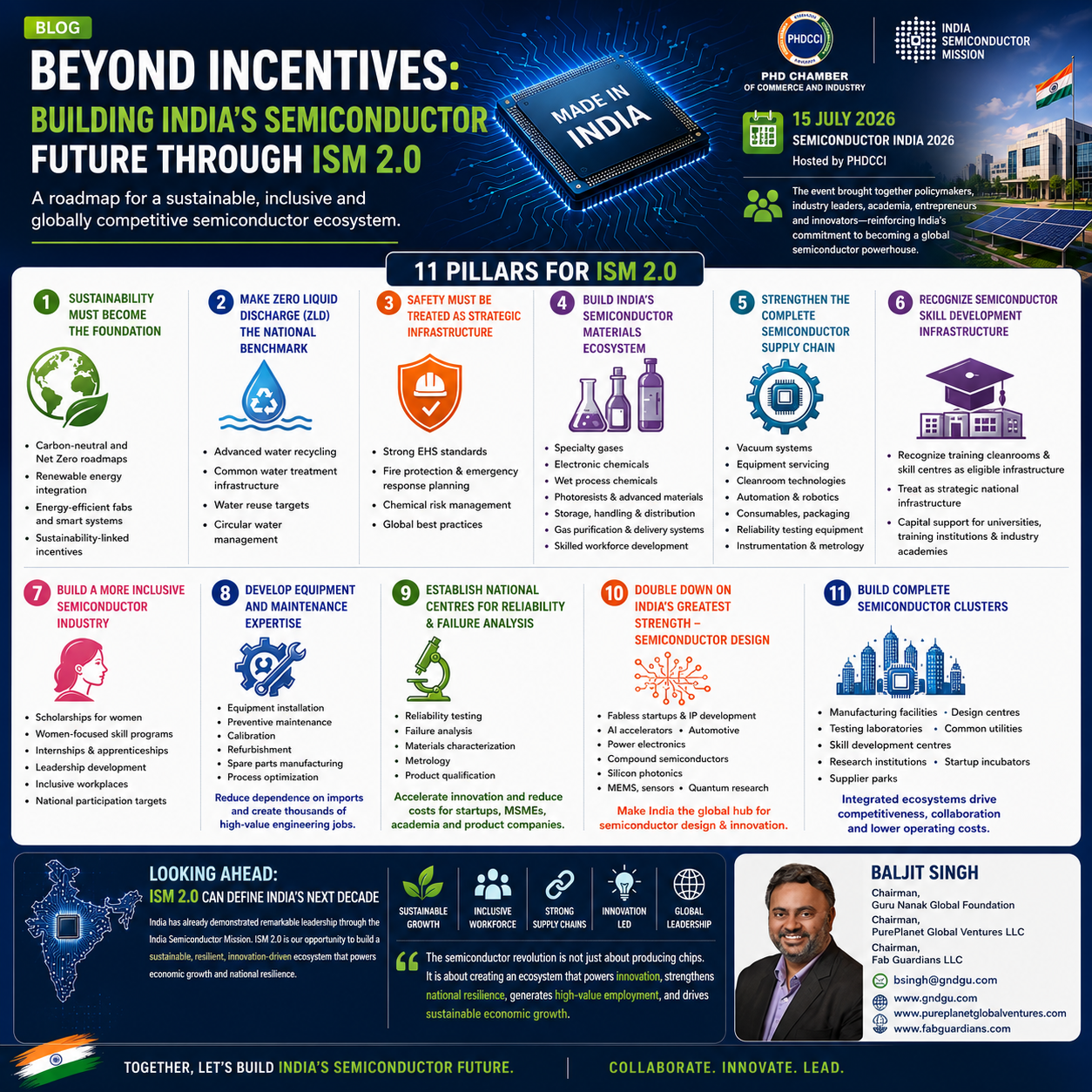
    On 15 July 2026, I had the privilege of attending SEMICONDUCTOR INDIA 2026, hosted by the PHD Chamber of Commerce and Industry (PHDCCI). The event brought together policymakers, industry leaders, academia, entrepreneurs, and innovators under one roof, reinforcing India’s unwavering commitment to becoming a global semiconductor powerhouse.

    I extend my sincere congratulations to Dr. Jatinder Singh, Shri Amitesh Kumar Sinha, and the entire organizing team for curating a meaningful platform that encouraged dialogue, collaboration, and a shared vision for India’s semiconductor future.

    Over the past few years, the India Semiconductor Mission (ISM) has successfully laid the foundation for attracting semiconductor investments and positioning India on the global semiconductor map. However, as we enter the next phase of growth, ISM 2.0 presents an opportunity to evolve from an investment-driven initiative into a comprehensive national ecosystem strategy.

    India has the opportunity not merely to replicate existing semiconductor hubs but to build the world’s most sustainable, resilient, inclusive, and innovation-driven semiconductor ecosystem.

    1. Sustainability Must Become the Foundation

    Every semiconductor facility approved under ISM 2.0 should be designed with sustainability at its core.

    India has the opportunity to become home to some of the world’s greenest semiconductor facilities by encouraging:

    • Carbon-neutral and Net Zero manufacturing roadmaps.
    • Renewable energy integration through solar, wind, battery storage, and green hydrogen.
    • Energy-efficient fabs powered by digital energy management systems.
    • Sustainability-linked incentives tied to measurable environmental outcomes.

    Future competitiveness will increasingly depend not only on manufacturing capability but also on environmental responsibility.

    2. Make Zero Liquid Discharge the National Benchmark

    Semiconductor manufacturing is among the most water-intensive industries in the world.

    India should establish Zero Liquid Discharge (ZLD) as the standard for new semiconductor fabs, ATMP/OSAT facilities, and advanced packaging plants.

    Policy support should encourage:

    • Advanced water recycling technologies.
    • Common water treatment infrastructure within semiconductor parks.
    • Water reuse targets.
    • Circular water management systems.

    Responsible water stewardship will be critical to ensuring long-term sustainability and community acceptance.

    3. Safety Must Be Treated as Strategic Infrastructure

    Semiconductor manufacturing involves hazardous chemicals, specialty gases, and highly sophisticated manufacturing environments.

    Safety should not simply be a compliance requirement—it should become a strategic pillar of ISM 2.0.

    India should establish national semiconductor standards covering:

    • Environmental, Health and Safety (EHS).
    • Fire protection systems.
    • Emergency response planning.
    • Chemical risk management.
    • Global operational best practices.

    Safe facilities are productive facilities.

    4. Build India’s Semiconductor Materials Ecosystem

    A semiconductor ecosystem cannot thrive without domestic capabilities in critical materials.

    Priority investments should focus on:

    • Ultra-high purity specialty gases.
    • Electronic chemicals.
    • Wet process chemicals.
    • Photoresists.
    • Chemical storage and distribution.
    • Gas purification and delivery systems.

    Equally important is building a skilled workforce capable of safely handling these advanced materials.

    5. Strengthen the Complete Semiconductor Supply Chain

    Success in semiconductors extends far beyond fabs.

    India must simultaneously develop industries supporting semiconductor manufacturing, including:

    • Vacuum systems.
    • Semiconductor equipment servicing.
    • Cleanroom technologies.
    • Precision manufacturing.
    • Automation and robotics.
    • Packaging materials.
    • Reliability testing equipment.
    • Analytical instrumentation.
    • Metrology solutions.

    Supporting these sectors through targeted incentives will deepen localization, strengthen resilience, and attract additional global investment.

    6. Recognize Semiconductor Skill Development Infrastructure

    One of the most significant policy gaps today is that Semiconductor Skill Development Centres, Training Cleanrooms, and Applied Learning Facilities are often not recognized as eligible infrastructure under many state incentive schemes.

    This creates an unintended barrier to workforce development.

    Training infrastructure should be treated as strategic national infrastructure alongside manufacturing facilities.

    Supporting universities, industry academies, and semiconductor training centers through capital incentives will help ensure India develops the workforce needed to support future growth.

    7. Build a More Inclusive Semiconductor Industry

    The semiconductor industry represents an extraordinary opportunity to increase women’s participation across advanced manufacturing and engineering.

    A national strategy should include:

    • Scholarships for women pursuing semiconductor careers.
    • Dedicated skill development programs.
    • Industry internships and apprenticeships.
    • Leadership development pathways.
    • Inclusive workplace infrastructure.
    • National participation targets across technical and leadership roles.

    A stronger industry begins with a more diverse workforce.

    8. Develop Semiconductor Equipment and Maintenance Expertise

    Equipment represents one of the largest investments within semiconductor manufacturing.

    India should develop domestic capabilities in:

    • Equipment installation.
    • Preventive maintenance.
    • Calibration.
    • Refurbishment.
    • Spare parts manufacturing.
    • Process optimization.

    This capability will reduce reliance on overseas service providers while creating thousands of highly skilled engineering jobs.

    9. Establish National Centres for Reliability and Failure Analysis

    Many startups, universities, and product companies struggle to access advanced semiconductor testing facilities.

    India would benefit significantly from establishing shared national centres dedicated to:

    • Reliability testing.
    • Failure analysis.
    • Materials characterization.
    • Metrology.
    • Product qualification.

    Such facilities would accelerate innovation while reducing development costs for emerging semiconductor companies.

    10. Double Down on India’s Greatest Strength: Semiconductor Design

    Manufacturing is essential, but India’s greatest competitive advantage continues to be its engineering talent.

    ISM 2.0 should further accelerate investment in:

    • Fabless semiconductor companies.
    • Semiconductor IP development.
    • AI accelerators.
    • Automotive electronics.
    • Power electronics.
    • Compound semiconductors.
    • Silicon photonics.
    • MEMS and sensor technologies.
    • Quantum semiconductor research.

    India has the opportunity to become the world’s leading destination for semiconductor design and innovation.

    11. Build Complete Semiconductor Clusters

    Rather than isolated manufacturing investments, India should encourage integrated semiconductor clusters that combine:

    • Manufacturing facilities.
    • Design centres.
    • Testing laboratories.
    • Common utilities.
    • Skill development centres.
    • Research institutions.
    • Startup incubators.
    • Supplier parks.

    Integrated ecosystems lower operating costs, encourage collaboration, and improve global competitiveness.

    Looking Ahead: ISM 2.0 Can Define India’s Next Decade

    India has already demonstrated remarkable leadership through the India Semiconductor Mission.

    The next phase should focus on building an ecosystem that is not only capable of manufacturing chips but also developing talent, enabling innovation, strengthening domestic supply chains, and embedding sustainability into every aspect of growth.

    If India embraces these priorities, ISM 2.0 can become much more than an industrial policy—it can become a national transformation strategy that positions the country as a trusted global leader in semiconductor technology.

    The journey ahead requires continued collaboration between government, industry, academia, startups, and civil society. I remain optimistic that, together, we can build an ecosystem that future generations will regard as one of India’s defining technological achievements.

    The semiconductor revolution is no longer about producing chips alone. It is about creating an ecosystem that powers innovation, strengthens national resilience, generates high-value employment, and contributes to sustainable economic growth. India has both the vision and the talent to lead this transformation—and ISM 2.0 is the opportunity to make that vision a reality.


  • How Fab Guardians Helps Semiconductor Fabs Reduce Downtime and Extend Tool Life

    Keeping Critical Equipment Running

    In semiconductor manufacturing, even a short equipment interruption can affect throughput, yield, delivery schedules, and operating cost. Fabs need dependable support partners who understand the realities of complex toolsets, aging assets, spare parts availability, and the pressure to maintain consistent production performance.

    Fab Guardians was built to meet that need. As an independent semiconductor lifecycle solutions provider, the company supports wafer fabs, advanced packaging facilities, compound semiconductor manufacturers, research institutes, government labs, and OEMs with practical services designed to improve uptime, extend equipment life, and reduce avoidable cost.

    What Customers Need Most

    • Fast access to reliable spare parts
    • Experienced field service support for maintenance, troubleshooting, and recovery
    • Refurbishment strategies that improve asset utilization
    • Application engineering and consulting for process and equipment challenges
    • A responsive partner that can support both planned work and urgent requirements

    These needs are especially important in environments where equipment uptime directly influences output and customer commitments. A well-supported tool can continue delivering value far beyond its original service window when maintenance, refurbishment, and engineering decisions are handled with discipline.

    How Fab Guardians Creates Value

    Fab Guardians combines spare parts support, field services, refurbishment, application engineering, consulting, and digital fab solutions into one lifecycle-focused offering. This integrated approach helps customers address immediate operational issues while also improving long-term equipment reliability and cost efficiency.

    The goal is not only to fix problems quickly, but to help fabs operate with greater resilience, predictability, and confidence.

    Support Across the Equipment Lifecycle

    • Spare Parts: Helping customers source the components needed to keep critical systems running.
    • Field Services: Supporting installation, preventive maintenance, corrective maintenance, relocation, and on-site technical intervention.
    • Refurbishment: Extending the useful life of equipment and subsystems through careful restoration and performance-focused service.
    • Engineering Support: Providing application insight and technical problem-solving for demanding fab environments.
    • Consulting and Digital Solutions: Helping organizations improve decision-making, visibility, and operational performance.

    Built for a Demanding Industry

    Semiconductor operations require precision, speed, and trust. Fab Guardians positions itself around experienced professionals with deep knowledge in equipment, process engineering, manufacturing, and supply chain management. That experience helps customers navigate both routine service needs and more complex lifecycle decisions with a practical, results-oriented mindset.

    For organizations looking to improve uptime, protect yield, and get more value from existing assets, the right support partner can make a measurable difference. Fab Guardians is focused on delivering that support with technical depth, responsiveness, and a clear understanding of fab priorities.

    Looking Ahead

    As fabs continue balancing expansion, cost pressure, and technology complexity, lifecycle support will remain a strategic priority. Fab Guardians is committed to helping customers strengthen operations through dependable service, engineering expertise, and solutions that support long-term manufacturing performance.